F-1-D Digital Nomad Visa Korea: Complete 2026 Guide & Requirements
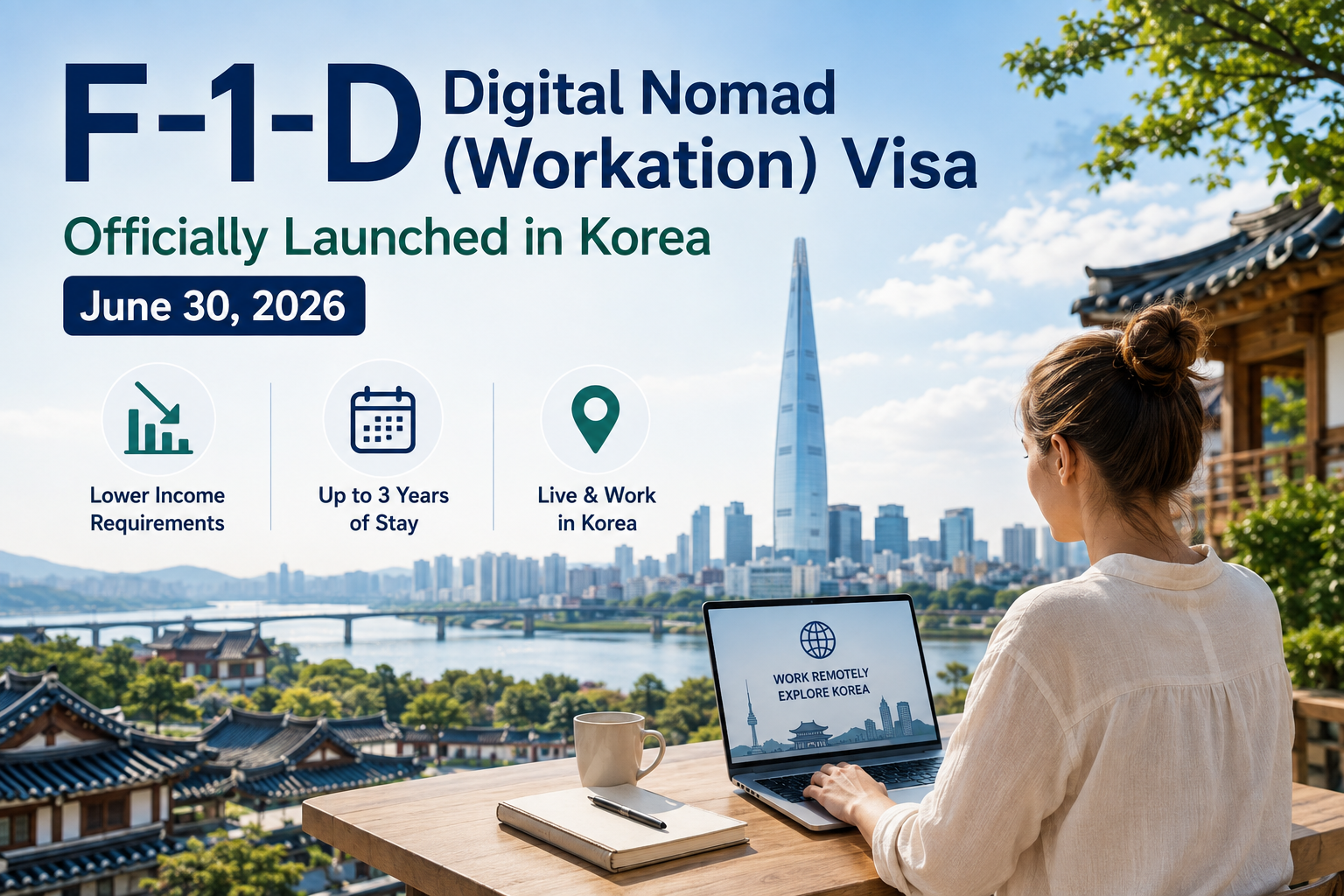
The F-1-D Digital Nomad Visa Korea (commonly referred to as the Workation Visa) entered an exciting new phase on June 30, 2026, when the Korean Ministry of Justice officially transitioned the program from a pilot initiative into a permanent, fully operational visa category. First introduced on a test-run basis in January 2024, the updated program introduces lowered income thresholds, strong incentives to reside outside the Seoul metropolitan area, and an extended stay of up to three years.
Whether you are planning to work remotely from Seoul, Busan, Jeju, or regional hubs across South Korea, this comprehensive guide outlines everything you need to know about eligibility, updated income requirements, family rules, health insurance, and applying in 2026.
Disclaimer: This article provides general informational guidance based on announcements by the Ministry of Justice and Korea Immigration Service. It does not constitute individualized legal advice. If you require legal assistance with your application, please consult our team at Pureum Law Office.
What Is the F-1-D Digital Nomad Visa Korea?
The F-1-D Digital Nomad Visa allows foreign nationals employed by overseas companies to live in South Korea while continuing to work remotely. Until the visa was established, foreign remote workers had to rely on short-term tourist visas or visa-free entry (generally restricted to 90 days), forcing them to leave the country once their short-term stay expired.
The F-1-D visa eliminates this inconvenience, allowing remote professionals, freelancers, and employees of foreign entities to stay legally in South Korea for extended periods while enjoying the nation’s culture, infrastructure, and nature.
Crucial Restriction: The F-1-D visa strictly prohibits domestic employment or profit-making activities within South Korea. Visa holders cannot work for Korean companies or contract with domestic clients. A separate domestic work visa is required for Korean employment.
Key 2026 Updates: From Pilot to Permanent Program
When South Korea’s Ministry of Justice reviewed the pilot period (January 2024 to May 2026), official data showed that 743 digital nomad visas had been issued, with approximately 70% of registered holders originating from OECD member countries. However, roughly 85% of visa holders concentrated heavily in the Seoul Metropolitan Area (Seoul, Gyeonggi Province, and Incheon).
To promote regional equity and revitalize local economies outside the capital, the Ministry of Justice formally updated the F-1-D program on June 30, 2026 with three major reforms:
- Tiered Income Requirements: Lower financial requirements for younger applicants (ages 18–34) and those choosing to reside outside the Seoul metropolitan area.
- Extended Stay Duration: Maximum stay increased from 2 years to 3 years.
- Formalized In-Country Status Change: Explicit pathways for visitors on short-term tourist visas (B-1, B-2, C-3) to switch to F-1-D without leaving Korea.
Eligibility Requirements
To qualify as the principal applicant for the F-1-D Digital Nomad Visa, you must satisfy the following basic conditions:
- Age: Must be at least 18 years old.
- Employment: Must be employed by or associated with an overseas company capable of supporting remote work.
- Work Experience: Must have worked in the same industry/field for at least one (1) year.
- Financial Sufficiency: Must meet the applicable Gross National Income (GNI) threshold based on your age, location, and family status.
- Clean Background & Health Insurance: Must pass background checks and hold compliant private health insurance.
New 2026 Income Requirements
During the 2024 pilot period, all applicants were required to earn at least two times (2×) Korea’s per-capita Gross National Income (GNI). Under the permanent 2026 policy, income requirements depend directly on your age and intended region of residence in Korea.
Based on the reference per-capita GNI of approximately KRW 52.41 million, the minimum income thresholds for a Korean Digital Nomad Visa are structured as follows:
| Applicant Age | Seoul Metropolitan Area (Seoul/Gyeonggi/Incheon) | Non-Metropolitan / Population-Decline Areas |
|---|---|---|
| Ages 18–34 | 1.5× GNI (~KRW 78.62 Million) | 1.0× GNI (~KRW 52.41 Million) |
| Ages 35 and older | 2.0× GNI (~KRW 104.83 Million) | 1.5× GNI (~KRW 78.62 Million) |
*Note: Designated population-decline or population-decline-concern areas qualify for the reduced threshold. Applicants applying under regional thresholds must provide documentation confirming actual regional stay (e.g., lease agreement of at least 1 month, workation facility booking, or hotel/accommodation reservation).
Rules for Accompanying Family Members
Principal F-1-D visa holders may bring their spouse and minor children. There is no minimum age requirement for accompanying children.
Important Income Adjustment for Families: Bringing family members modifies the applicable income threshold:
- If residing in the Seoul Metropolitan Area with family: The income threshold is fixed at 2.0× GNI regardless of the principal applicant’s age.
- If residing in a Non-Metropolitan Area with family: The income threshold is fixed at 1.5× GNI regardless of the principal applicant’s age.
Period of Stay: Extended to 3 Years
Under the revised 2026 framework, digital nomads can reside in Korea for up to three (3) years in total (increased from the previous 2-year cap):
- Initial Granted Stay: 1 year (activated upon foreigner registration/alien registration post-entry).
- Extensions: Granted in 1-year increments upon meeting renewal requirements.
- Maximum Duration: Up to 3 years total stay.
Required Documents & Health Insurance
To lodge a complete application at a Korean Embassy/Consulate abroad or at a local immigration office in Korea, prepare the following items:
- Standard Visa Application Form
- Valid Passport & Passport-sized Photo
- Application Fee
- Certificate of Employment (proving at least 1 year in the current industry)
- Proof of Income & Remote Capability (Pay slips, tax certificates, bank statements)
- Criminal Background Record Check (Apostilled or Consular Authenticated)
- Proof of Housing / Lease Agreement (Especially critical for regional income threshold applicants)
- Family Relationship Certificates (If accompanied by spouse or children)
- Private Health Insurance Certificate: Must provide explicit coverage of at least KRW 100 million for medical treatment and emergency repatriation during your entire stay. Standard travel policies without repatriation or sufficient coverage limits will be rejected.
Changing Status to F-1-D While Inside Korea
If you are currently visiting South Korea on an eligible short-term status—such as B-1 (Visa-Exempt), B-2 (Tourist), or C-3 (Short-Term Visit)—you can apply to change your status to F-1-D directly through a local Korean immigration office without departing the country.
While in-country changes are permitted, approval is not automatic. Applicants must present all required documentary proof (including criminal history and income verification) that meets official standards.
How long can I stay in South Korea on an F-1-D visa?
The initial visa grant is for 1 year, extendable annually up to a total maximum stay of 3 years under the permanent 2026 rules.
Can I work for a local South Korean client or business?
No. The F-1-D visa is strictly for remote work tied to overseas employers or clients. Local employment or domestic revenue generation is strictly forbidden.
Is living outside Seoul required?
No. You may live anywhere in Korea. However, choosing a location outside the Seoul metropolitan area significantly lowers the income required to qualify.
Can my spouse or children work locally in Korea?
Accompanying family members hold dependent status tied to the principal applicant and are also restricted from domestic employment unless they separately qualify and change to an independent work visa.
Planning Your F-1-D Visa Application? Contact Pureum Law Office
If you have questions about the F-1-D Digital Nomad Visa Korea, including eligibility, income requirements, required documents, accompanying family members, or changing your status while already in Korea, please contact Pureum Law Office or email us at ask@pureumlawoffice.com.
For official immigration announcements and updates, you may also consult the Korea Immigration Service and the Ministry of Justice’s official announcement on the 2026 Digital Nomad Visa changes.
This article is for general informational purposes only and does not constitute legal advice. Visa requirements, documentary standards, and immigration practices may change, and individual cases should be evaluated based on their specific circumstances.

Paralegal | Marketing Lead
Diane Jeong is a junior paralegal overseeing the Pyeongtaek branch, and acts as Pureum's in-house marketing manager.