Korea AI Basic Act Domestic Agent: Ultimate 2026 Guide to Avoid Fines
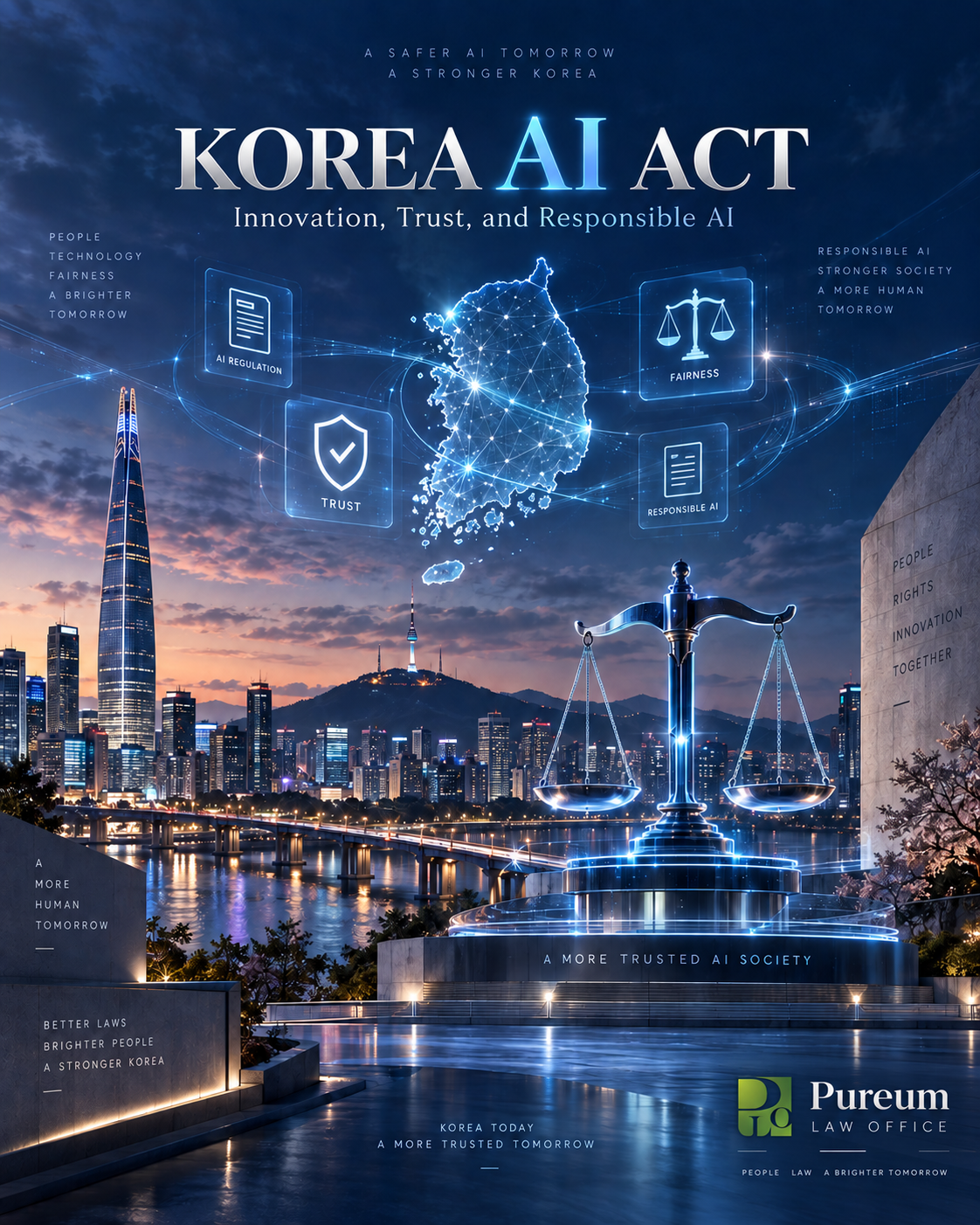
A Korea AI Basic Act domestic agent is now required for major overseas AI companies serving Korean users without a Korean office. Korea’s AI Basic Act took effect on January 22, 2026. Under Article 36, qualifying foreign AI business operators must appoint a local agent in writing and report the appointment to the Ministry of Science and ICT (MSIT).
Failing to appoint an agent can result in a fine of up to KRW 30 million. This guide from Pureum Law Office explains who must appoint an agent, what the agent does, and how our team can help.
Table of Contents
- What Is a Korea AI Basic Act Domestic Agent?
- Who Must Appoint One?
- What the Agent Does
- Penalties and the Grace Period
- AI Basic Act vs. PIPA Domestic Agents
- Our Korea AI Basic Act Domestic Agent Services
- FAQs
What Is a Korea AI Basic Act Domestic Agent?
The AI Basic Act (Basic Act on the Development of Artificial Intelligence and the Establishment of a Foundation for Trust) is Korea’s first comprehensive AI law. It applies to acts outside Korea if they affect the Korean market or Korean users.
A Korea AI Basic Act domestic agent is a person or entity with an address or place of business in Korea. The agent represents a foreign AI business operator on specific regulatory duties.
“AI business operators” include both AI developers and businesses that use AI developed by others to provide AI products or services.
Who Must Appoint a Korea AI Basic Act Domestic Agent?
The obligation applies to AI business operators with no address or place of business in Korea that meet any one of these criteria under Article 29 of the Enforcement Decree:
| Criterion | Threshold |
|---|---|
| Total revenue | KRW 1 trillion or more in the previous year |
| AI service revenue | KRW 10 billion or more from AI services in the previous year |
| Korean users | A daily average of 1 million or more Korean users of its AI products and services, over the three months before the end of the previous year |
| Prior fine | Previously fined for failing to comply with an MSIT suspension or corrective order |
Revenue is converted into Korean won at the previous year’s average exchange rate.
The second criterion deserves close attention. A company with modest overall revenue can still qualify if its AI service revenue reaches KRW 10 billion.
The fourth criterion is also significant. One ignored corrective order can create a new domestic agent obligation.
What the Agent Does
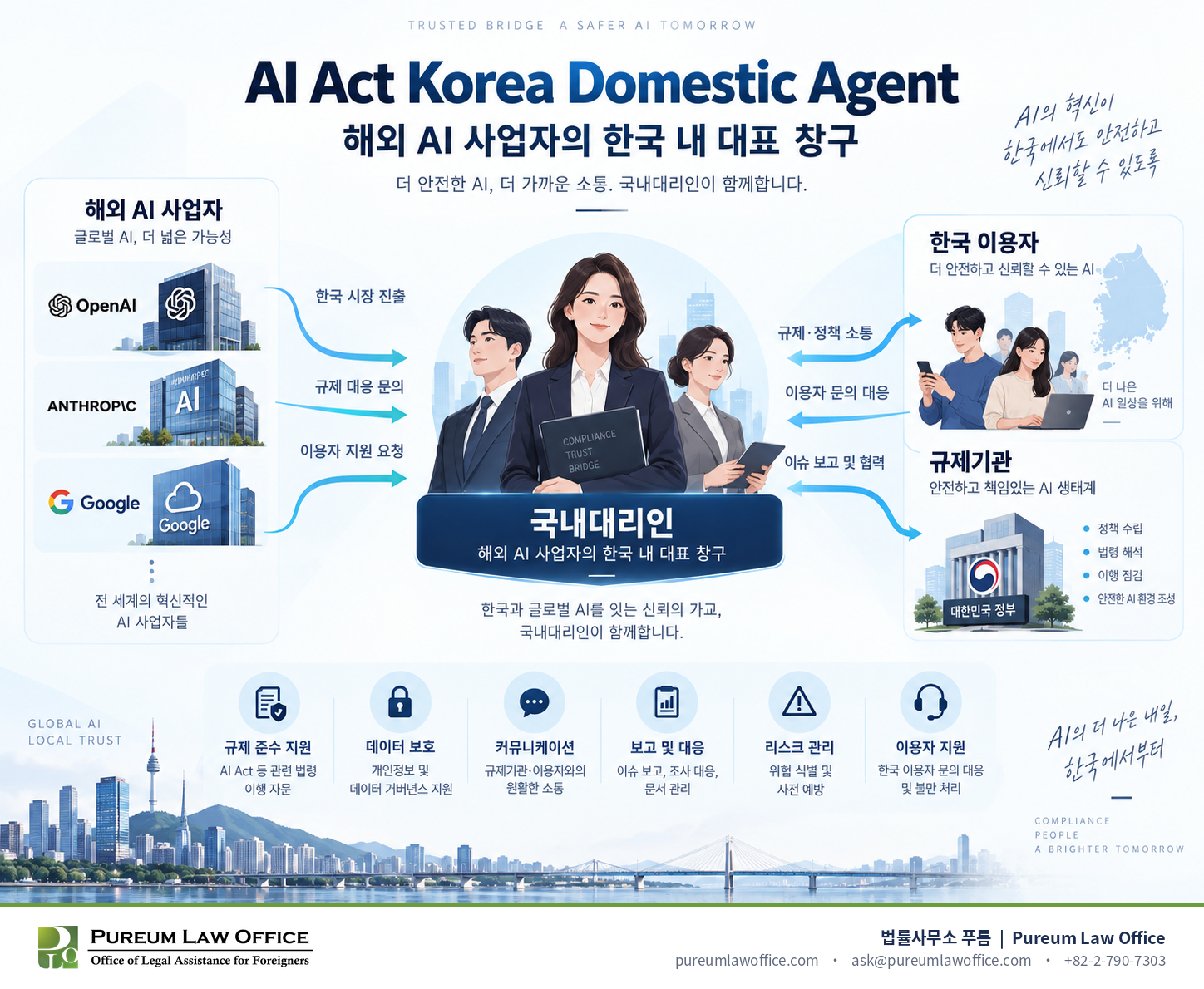
The agent handles three tasks under Article 36(1):
- Safety reporting for high-compute AI: Submitting the results of safety measures for AI systems trained with cumulative compute of 10²⁶ FLOPs or more that use state-of-the-art AI technology (Article 32).
- High-impact AI confirmation: Requesting MSIT’s confirmation of whether an AI system qualifies as “high-impact AI” (Article 33).
- High-impact AI compliance support: Supporting risk management, explainability, user protection, human oversight, and documentation measures, including checking that records are current and accurate (Article 34).
High-impact AI covers AI used in sensitive areas such as energy supply, healthcare, medical devices, hiring and loan screening, transportation, and student evaluation.
Any violation by the agent in performing these tasks is treated as a violation by the AI business operator itself.
Penalties and the Grace Period
Under Article 43(1), failing to appoint a required domestic agent can lead to a fine of up to KRW 30 million. The same cap applies to failing to give advance notice that a product or service uses generative or high-impact AI, and to ignoring MSIT’s corrective orders.
The Korean government has announced a guidance period of at least one year from the Act’s enforcement, during which sanctions such as fact-finding investigations and fines will generally not be imposed, except in exceptional cases involving serious harm such as loss of life. Datalaw
However, this grace period is an administrative policy, not a legal exemption. The appointment obligation already applies, and companies should use this time to prepare.
AI Basic Act vs. PIPA Domestic Agents
Many AI companies also process personal data and may need agents under both laws. The key differences are:
| Item | AI Basic Act | PIPA |
|---|---|---|
| Regulator | MSIT | PIPC |
| Revenue thresholds | KRW 1 trillion total, or KRW 10 billion from AI services | KRW 1 trillion total |
| User threshold | 1 million daily Korean users | 1 million daily Korean data subjects |
| Report to regulator | Required | Not required; disclosure in privacy policy |
| Korean affiliate rule | None | Korean subsidiary or controlled entity must be appointed |
| Maximum fine for non-appointment | KRW 30 million | KRW 20 million |
For details, see our guide on the PIPA domestic agent in Korea.
Our Korea AI Basic Act Domestic Agent Services
Pureum Law Office serves as a Korea AI Basic Act domestic agent for overseas AI companies. Our services include:
- Threshold assessment: Reviewing your total revenue, AI service revenue, and Korean user numbers.
- Appointment and reporting: Preparing a bilingual written appointment and filing the report with MSIT.
- High-impact AI review: Assessing whether your system may be high-impact AI and handling confirmation requests.
- Compliance support: Helping maintain risk management, user protection, and documentation records.
- Transparency review: Checking AI notices and labeling of generated content under Article 31.
- Regulatory liaison: Communicating with MSIT in Korean on your behalf.
Our English-speaking team includes Korean- and US-licensed attorneys, and we carry professional liability insurance. We also serve as a PIPA domestic agent in Korea and a Korea Game Domestic Agent, so companies subject to more than one Korean regime can work through a single point of contact.
Appoint Your Korea AI Basic Act Domestic Agent Today
The grace period is the best time to build a compliant structure before enforcement begins. Early preparation protects your business and your access to the Korean market.
We can act as a Domestic Agent Services in Korea for Foreign Companies, so contact Pureum Law Office at ask@pureumlawoffice.com or (+82) 02-790-7303 to schedule a consultation.
Korea AI Basic Act Domestic Agent FAQs
When did the AI Basic Act take effect?
The Act took effect on January 22, 2026.
Does the Act apply to companies outside Korea?
Yes. Article 4 applies the Act to acts outside Korea that affect the Korean market or Korean users.
Must we report the appointment to the government?
Yes. Article 36(1) requires both a written appointment and a report to MSIT.
Can a law firm serve as our agent even if we have a Korean subsidiary?
The AI Basic Act only requires the agent to have an address or place of business in Korea. Unlike PIPA, it does not require you to appoint a Korean affiliate. Your structure should still be reviewed case by case.
Does the grace period mean we can wait?
No. The grace period concerns enforcement, not the obligation itself. Once it ends, non-compliant companies may face fines.
Contact Pureum Law Office
- Phone: (+82) 02-790-7303
- Email: ask@pureumlawoffice.com
- Business Hours: Monday – Friday, 9:00 AM – 6:00 PM KST
- Seoul Office: Unit 608, Tower, 17 Seobinggo-ro, Yongsan-gu, Seoul
- Pyeongtaek Office: 25-6 Songhwa-ri, 3rd Floor, Pyeongtaek-si
This article is provided for general informational purposes only and does not constitute legal advice for individual circumstances. Consult Pureum’s lawyers for advice specific to your situation.
ATTORNEY | Founding Partner
Leveraging his vast experience and comprehensive knowledge, Simon has become an invaluable resource for foreigners facing a wide array of legal issues in Korea.