
Supreme Court Visitation Rights Korea has taken an important step forward following a significant victory in a case handled with the involvement of Pureum Law Office. On July 16, 2026, the Supreme Court of Korea reversed a lower court ruling that had refused to determine a non-custodial father’s visitation rights because the custodial parent and child could not be located.
The Supreme Court held that practical difficulty in immediately arranging visitation cannot, by itself, justify depriving a parent of a legally protected right to maintain contact with his or her child.
The decision is particularly significant for international families, where a parent may relocate abroad with a child and the non-custodial parent may have difficulty determining their exact location.
Pureum Law Office is proud to have contributed to the legal efforts that resulted in this important Supreme Court victory.
Supreme Court Visitation Rights Korea: Background of the Case
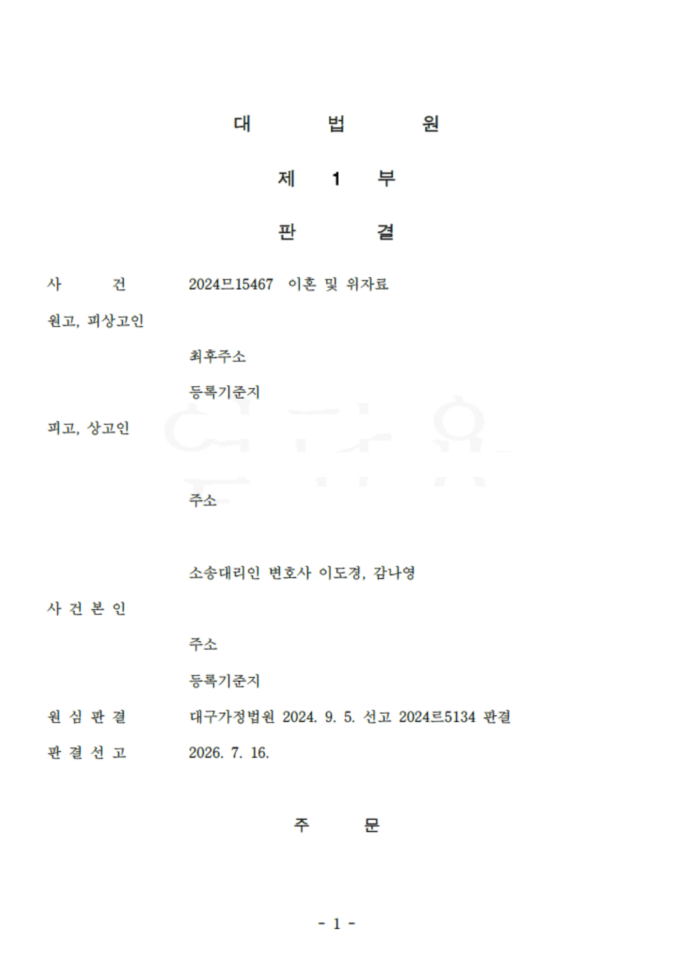
The parties married in Korea in 2013 and had one child.
They later lived together in Australia. According to the Supreme Court judgment, in approximately September 2019, the mother returned to Korea with the child without informing the father. The parents thereafter lived separately.
In September 2020, the mother commenced divorce proceedings in Korea.
Attempts to serve the father at his Australian address were unsuccessful, and the proceedings eventually continued through service by public notice. In October 2021, the first-instance court granted the divorce and ordered the father to pay KRW 20 million in damages and KRW 500,000 per month in child support.
The first-instance court did not establish visitation between the father and child.
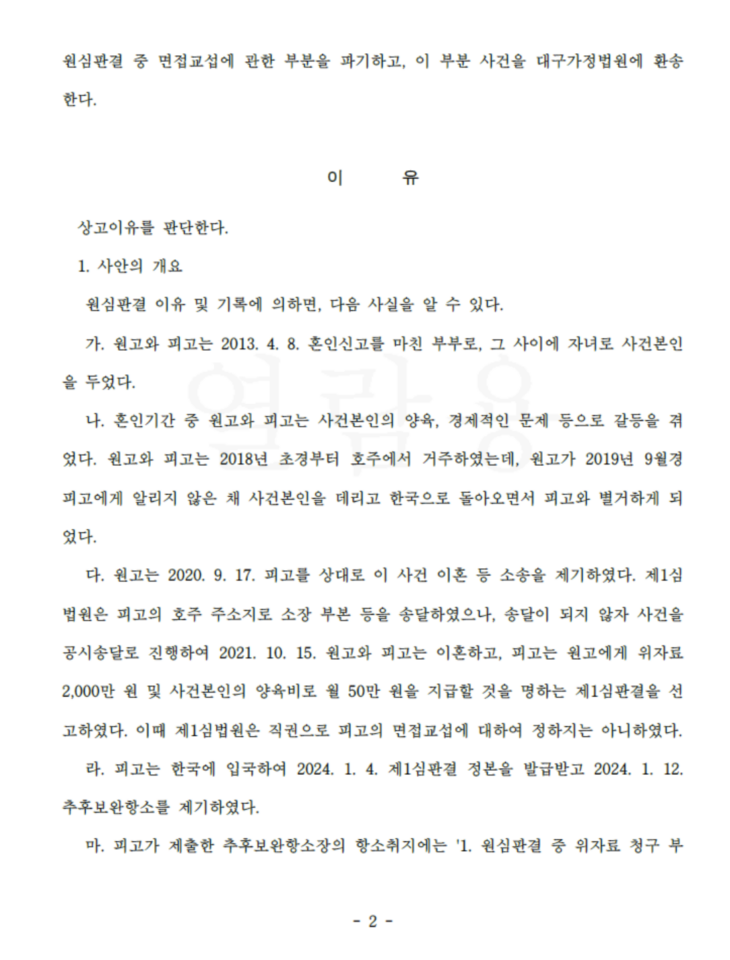
The father later entered Korea, obtained the judgment in January 2024, and filed an appeal. He challenged the damages award and expressly sought visitation with his child, including proposing specific methods of contact.
There was another major complication.
The mother had left Korea with the child for Canada in approximately 2021, and their exact whereabouts could not be established.
During the appeal, efforts were made to locate them. The mother’s own mother was even examined as a witness, but the precise location of the mother and child remained unknown.
The Father Won the Damages Appeal but Was Denied Visitation
The Daegu Family Court accepted the father’s appeal regarding damages.
It reversed the portion of the first-instance judgment requiring him to pay KRW 20 million and dismissed the mother’s corresponding claim.
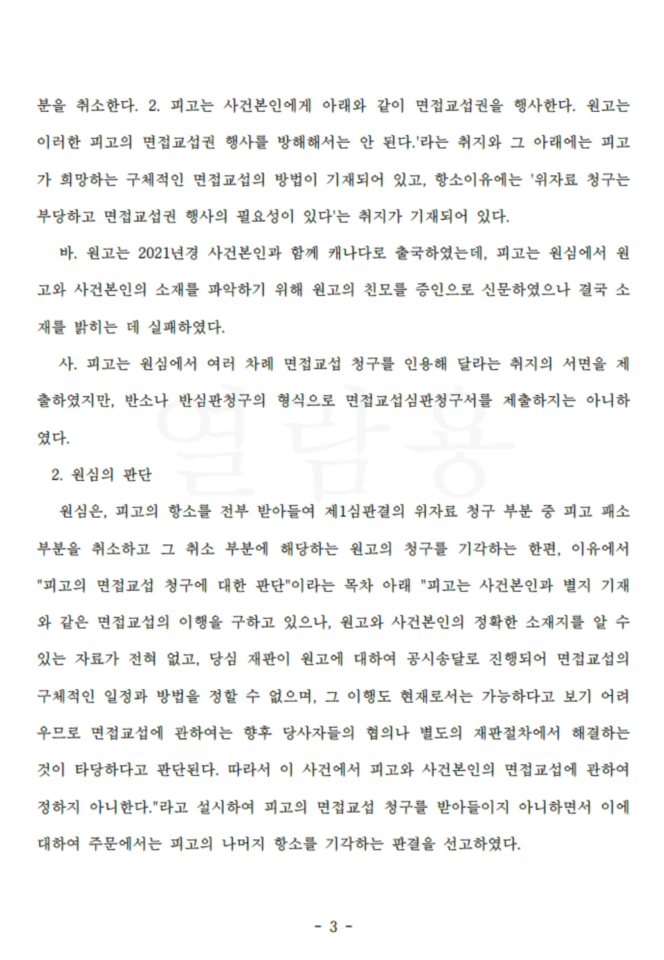
However, the appellate court refused to establish visitation.
The court reasoned that because the exact location of the mother and child was unknown, it was impossible to determine a practical schedule and method of visitation. It also considered immediate implementation difficult.
The appellate court therefore concluded that visitation should instead be resolved through future agreement between the parents or separate proceedings.
The father challenged that conclusion before the Supreme Court of Korea.
Supreme Court Victory: Difficulty in Enforcement Is Not Enough
The Supreme Court reversed the visitation portion of the appellate judgment and sent the matter back to the Daegu Family Court.
The central legal principle was clear.
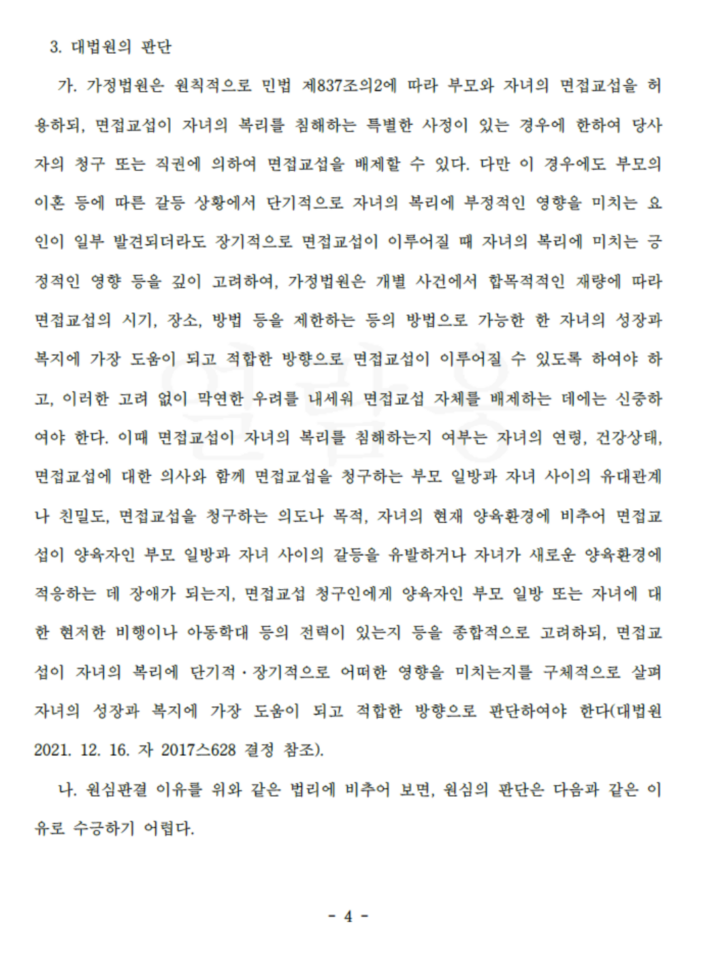
Under Article 837-2 of the Korean Civil Act, contact between a parent and child should generally be permitted. Visitation may be excluded only where special circumstances demonstrate that contact would be contrary to the welfare of the child.
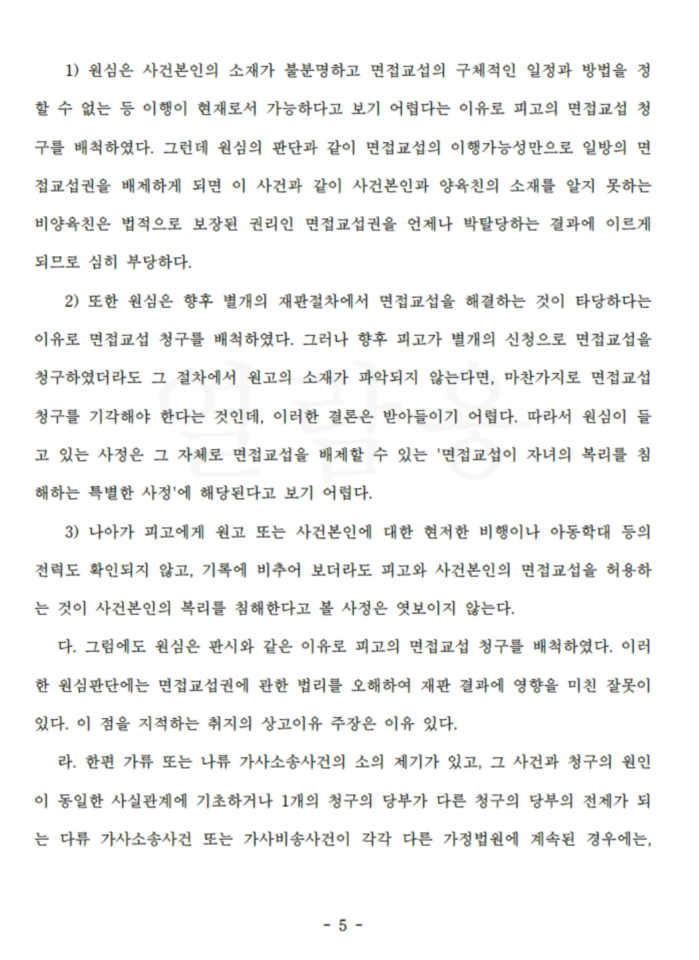
The appellate court had focused primarily on whether visitation could presently be implemented.
The Supreme Court held that this was the wrong approach.
If practical enforceability alone were sufficient to deny visitation, a non-custodial parent who could not locate the custodial parent and child could effectively lose his or her legally protected visitation rights indefinitely.
The Supreme Court described such a result as seriously unjust.
This makes the ruling an important development for Supreme Court Visitation Rights Korea and international family disputes involving children who have been taken or relocated overseas.
An Unknown Address Does Not Eliminate Parental Rights
One of the most important aspects of the judgment concerns the child’s unknown location.
The appellate court effectively reasoned that because the mother and child could not be located, a concrete visitation arrangement could not presently be implemented.
The Supreme Court rejected that reasoning as a sufficient legal basis for denying visitation.
The problem becomes obvious when the reasoning is followed to its logical conclusion.
Suppose the father filed a completely separate visitation case, as suggested by the appellate court. If the mother and child still could not be located, the same reasoning could again be used to reject the new application.
The father could therefore remain unable to exercise visitation indefinitely precisely because he could not locate his child.
The Supreme Court found that this could not be the correct application of Korean family law.
The inability to locate the custodial parent or child does not, by itself, constitute the type of special circumstance necessary to establish that visitation would harm the child’s welfare.
The Child’s Best Interests Remain the Central Standard
The Supreme Court did not establish an absolute rule that visitation must always be granted.
Instead, it reaffirmed that the child’s welfare must remain the controlling consideration in determining child visitation rights in Korea.
Korean family courts should consider factors including:
- the child’s age and health;
- the child’s wishes regarding visitation;
- the relationship and emotional bond between the child and non-custodial parent;
- the parent’s purpose in requesting visitation;
- the child’s existing living and caregiving environment;
- whether visitation may interfere with the child’s adjustment to that environment; and
- whether the requesting parent has a history of serious misconduct or child abuse.
The court must consider both the short-term and long-term effect that visitation may have on the child.
Importantly, even where legitimate concerns exist, the solution does not necessarily have to be the complete denial of contact.
A family court may instead regulate the time, place, frequency, or method of visitation so that contact can occur in a manner consistent with the child’s welfare.
The Supreme Court cautioned courts against excluding parent-child contact based merely on generalized or speculative concerns.
No Evidence That Contact Would Harm the Child
The factual findings were also important to the result.
The Supreme Court specifically noted that there was no confirmed history of serious misconduct or child abuse by the father against the mother or child.
The record also did not reveal circumstances demonstrating that allowing contact between the father and child would harm the child’s welfare.
Accordingly, the fact that the mother’s and child’s location was unknown did not satisfy the legal standard required to exclude visitation.
The Supreme Court concluded that the appellate court had misunderstood the law governing visitation rights and that this error had affected the outcome of the case.
The father’s Supreme Court argument on this issue was therefore accepted.
An Important Procedural Ruling on Visitation Claims
The judgment is significant for another reason.
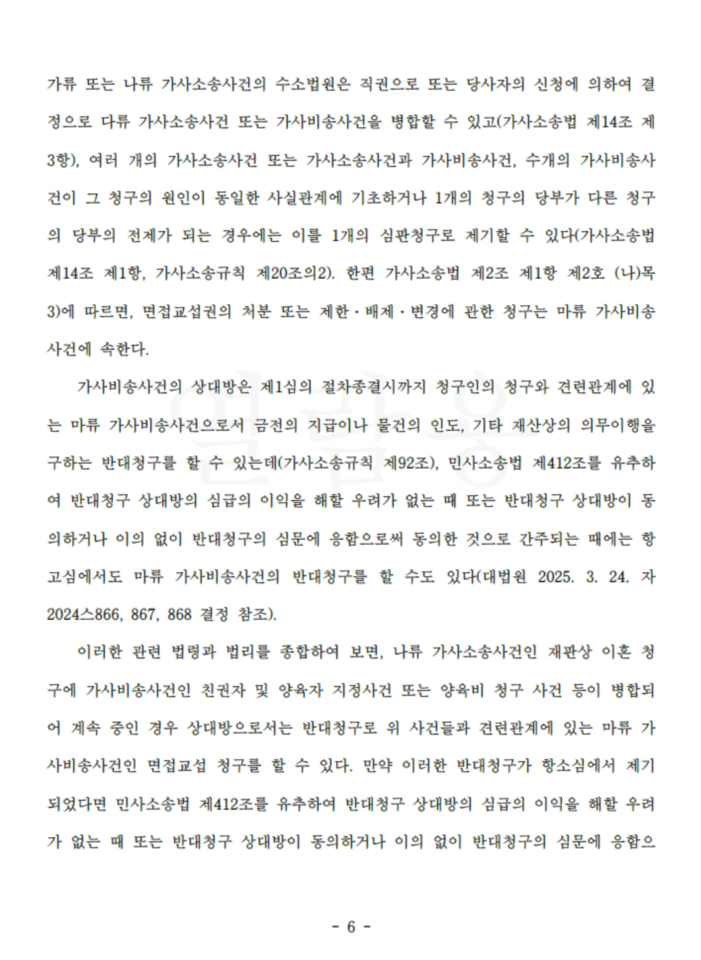
The Supreme Court also addressed how a visitation claim can be raised during existing Korean divorce, custody, and child-support proceedings.
During the appeal, the father had repeatedly requested visitation and had included specific visitation arrangements in his appellate submissions.
However, he had not filed a separate document formally titled as a counterclaim or counter-petition for visitation.
This raised an important procedural question.
The Supreme Court explained that when a judicial divorce case is already combined with matters such as designation of the custodial parent or child support, the opposing party may, under appropriate circumstances, bring a related visitation claim as a counterclaim.
The Supreme Court further recognized that such a counterclaim may potentially be raised even at the appellate stage.
Whether it is permitted depends on procedural requirements, including whether the opposing party’s right to have the matter properly reviewed through the court system would be prejudiced and whether the opposing party consented or participated without objection.
What the Court on Remand Must Decide
The Supreme Court therefore gave specific instructions to the Daegu Family Court.
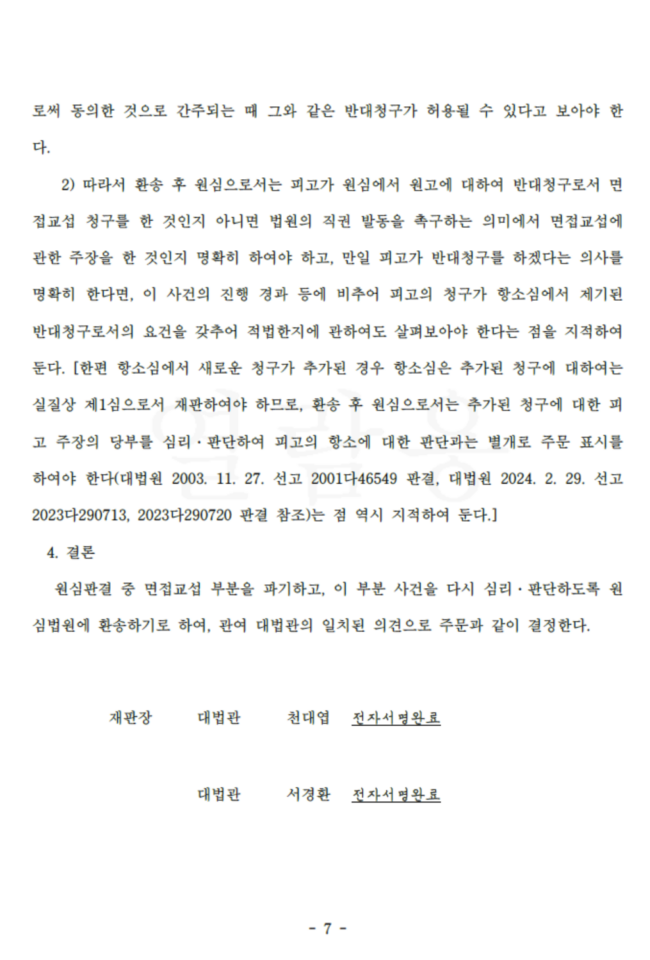
On remand, the court must first clarify the legal nature of the father’s previous visitation request.
It must determine whether he intended to formally assert visitation as a counterclaim or whether his submissions merely requested that the family court exercise its authority on its own initiative.
If the father makes clear that he intended to pursue a counterclaim, the court must then determine whether that claim satisfies the procedural requirements for a counterclaim raised at the appellate stage.
The Supreme Court also emphasized another important procedural point.
Where a genuinely new claim is added during an appeal, the appellate court effectively acts as the court of first instance for that new claim. It must therefore independently hear and decide that claim and reflect its determination separately in the operative part of the judgment.
This procedural guidance may influence how visitation claims are presented in future Korean divorce and custody litigation.
Why This Supreme Court Visitation Rights Korea Decision Matters
This case has particular importance for foreign and international families.
Cross-border divorces can create problems that are less common in purely domestic cases.
A parent may suddenly relocate to another country with a child. The non-custodial parent may know the country but not the child’s address. Communication may stop. International service can become difficult, and the parent may be unable to participate effectively in Korean proceedings.
In this case, the family had lived in Australia, the mother returned to Korea with the child, and the mother and child subsequently left for Canada.
The dispute therefore demonstrates how quickly a family case can become a multi-jurisdictional legal problem.
If the inability to locate a child were itself sufficient to deny visitation, the circumstances preventing contact could become the legal justification for continuing to prevent contact.
The Supreme Court rejected that circular result.
A Significant Protection for Non-Custodial Parents
The decision does not place parental rights above children’s interests.
It does something more carefully balanced.
It confirms that the child’s welfare is the legal standard while preventing practical obstacles from being mistaken for evidence that contact would harm the child.
This distinction is important.
There may be cases where visitation genuinely presents a risk to a child. Korean courts retain authority to restrict, structure, supervise, or exclude visitation where the evidence demonstrates that such measures are necessary for the child’s welfare.
But the court must make that determination based on the child’s interests and the relevant evidence.
The mere fact that exercising the right is presently difficult is not enough.
For foreign parents facing visitation rights in Korea, this provides an important clarification of the protection available under Korean family law.
Another Supreme Court Victory for Pureum Law Office
Pureum Law Office regularly represents foreign nationals in complex Korean divorce, custody, visitation, and other family-law matters.
This case required persistence through multiple stages of proceedings and presented substantial international and procedural difficulties.
The Supreme Court ultimately reversed the visitation portion of the lower court judgment and remanded the case for further proceedings.
The result is meaningful not only for the parent involved but also for the legal principles governing future international family disputes.
The judgment reinforces that a non-custodial parent’s legally protected relationship with a child cannot be disregarded simply because the custodial parent and child cannot presently be located.
It also provides useful procedural guidance concerning visitation claims raised in ongoing divorce proceedings and at the appellate level.
For Pureum Law Office, the decision represents another important Supreme Court result and another opportunity to contribute to the development and clarification of Korean law affecting international families.
International Divorce and Visitation Rights in Korea
Foreign parents involved in Korean family proceedings should obtain legal advice as early as possible.
Issues involving jurisdiction, international service, child custody, visitation, overseas relocation, and enforcement can become significantly more complicated once a parent or child leaves Korea.
Pureum Law Office assists foreign individuals with international divorce in Korea, child custody, child support, visitation rights, and other cross-border family disputes.
You can learn more about our Divorce and Family Law services and other successful cases on the Pureum Law Office website.
For the underlying Korean legal framework, the Korean Civil Act and information published by the Supreme Court of Korea provide authoritative resources concerning Korean family law and court procedures.
Conclusion
The Supreme Court Visitation Rights Korea decision of July 16, 2026 sends an important message: practical difficulty is not the same as legal justification.
A custodial parent’s and child’s unknown location may make visitation difficult to arrange, but that fact alone does not establish that contact would harm the child.
The proper inquiry remains the child’s welfare.
By reversing and remanding the lower court’s decision, the Supreme Court protected that principle while also safeguarding the legally recognized relationship between a child and a non-custodial parent.
Supreme Court of Korea, Case No. 2024Meu15467, Judgment dated July 16, 2026 — visitation portion reversed and remanded.
This article is provided for general informational purposes only and does not constitute legal advice. Past case results do not guarantee the same or similar results in other matters.

ATTORNEY | Founding Partner
Leveraging his vast experience and comprehensive knowledge, Simon has become an invaluable resource for foreigners facing a wide array of legal issues in Korea.